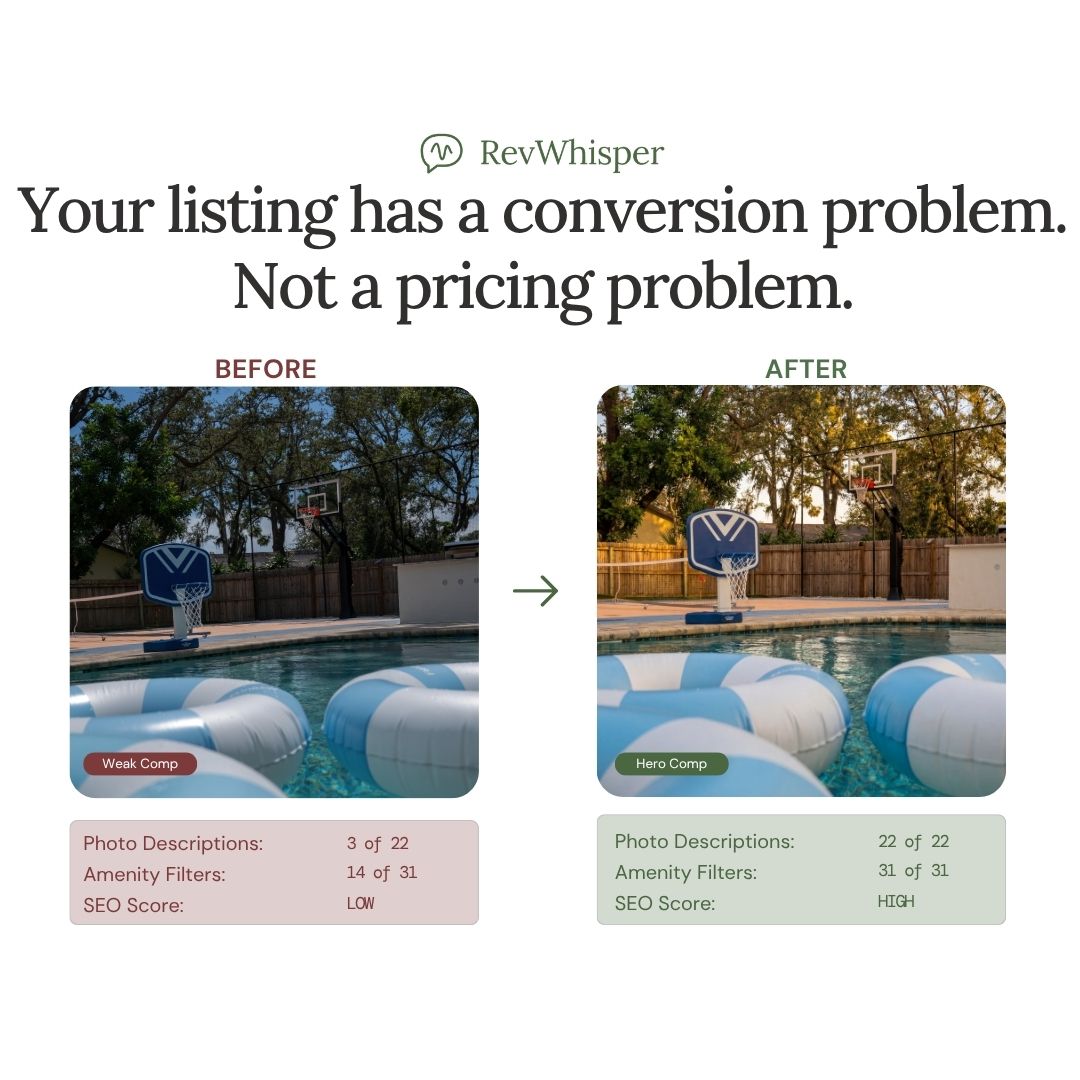
You are getting views but not bookings. That gap is not a pricing problem. It is a content problem, and the algorithm is watching every second of it.
Your Cover Photo Is a Revenue Decision
Airbnb’s algorithm tracks click-through rate as one of its 800+ ranking signals. A weak cover photo does not just lose the guest looking at it right now. It tells the algorithm your listing underperforms in search, which drops your ranking, which reduces future impressions. The compounding effect of a low-converting photo can cost you weeks of visibility.
Guests booking on the Airbnb app, now 64% of all bookings and growing 20% year over year, are scrolling faster than ever on a 5-inch screen. Your photo has one job: stop the scroll. Wide-angle shots of your living room do not stop scrolls. Natural light, a hero feature, and a clear sense of place do.
The difference between a 3% and a 6% click-through rate on a listing with 10,000 monthly impressions is 300 extra guests clicking through to your calendar every single month.
A cover photo that lifts your click-through rate by 3 percentage points on 10,000 monthly impressions generates 300 additional booking opportunities every month.
Data point: 64% of all Airbnb nights booked in Q4 2025 came from the app, up from 60% the prior year, meaning most guests are judging your photo on a small screen in under one second.
Your Title Is Filtering Out Your Best Guests
Most hosts write titles that describe the property. Smart hosts write titles that match what their best guest is searching for. Airbnb’s AI-powered natural language search is currently in testing and moving toward matching listings to conversational queries like “cozy cabin near skiing for a family of five.” If your title says “Charming 2BR Near Downtown,” you are invisible to that search.
A title formula that converts combines the guest outcome, the hero feature, and the proximity signal: “Mountain-View Cabin with Hot Tub, 8 Min to Slopes.” Every word is doing work.
Your title also sets ADR expectations before the guest sees the price. Airbnb’s Q4 2025 ADR averaged $168, driven by mix shift toward entire homes and properties that clearly signal premium value in search. If your title undersells the property, guests anchor to a lower price before they ever see your rate, and your conversion suffers before the negotiation starts.
A title built around guest outcome, hero feature, and proximity signal positions your listing for both current keyword search and Airbnb’s incoming AI-powered natural language discovery.
Data point: Airbnb Q4 2025 ADR reached $168, a 6% year-over-year increase, driven by listings that clearly signal entire home and premium value — the exact signals your title controls.
Your Description Has Three Jobs and Most Hosts Only Do One
Most hosts write descriptions that describe the property. That is one job. The other two are ranking and converting.
Ranking means the algorithm reads your description for keyword relevance across amenity categories, guest types, and experience signals. If you have a hot tub but the word “hot tub” does not appear in your first 250 characters, the algorithm may not surface you for hot tub searches.
Converting means structuring information so a guest can self-qualify in 20 seconds. Lead with the experience, not the square footage. Use the first paragraph to answer the question every guest is silently asking: is this the right place for my specific trip. Then move to amenities, house rules signals, and neighborhood context.
Amenities are not a checklist item. Airbnb’s Guest Favorite listings have driven 500 million nights booked since launch. Those listings share a common trait: complete, specific amenity data that reduces guest uncertainty before they book. Missing amenities in your listing data means missing from filtered searches, and filtered searches are where high-intent, ready-to-book guests live.
Your description must do three jobs simultaneously: signal keyword relevance to the algorithm, help high-intent guests self-qualify in 20 seconds, and eliminate the uncertainty that sends guests to a competitor.
Data point: Guest Favorite listings have generated 500M+ nights booked since the badge launched, and those listings consistently show complete amenity data, specific experience descriptors, and high review velocity.
Reviews and Superhost Status Are Algorithmic Assets, Not Vanity Metrics
A five-star review is not just social proof. It is an algorithmic signal that directly affects your search ranking position, your Guest Favorite eligibility, and your Superhost status, which in turn unlocks promotional priority during Airbnb’s algorithmic boost windows.
Promotions carry a 72-hour boost window where Airbnb amplifies your search visibility. Superhost listings get priority placement in that window. If you are not Superhost, you are competing for the same window with less algorithmic backing.
Review velocity also matters. Two reviews a month signals an active, trusted listing. Two reviews a year signals dormancy. The algorithm treats them differently.
Airbnb has removed 550,000+ listings since 2023 under its quality system. The platform is actively culling low-signal listings and rewarding high-signal ones. Your review strategy — including how you request reviews, when you follow up, and how you respond to every single review publicly — is a direct input into the system that determines how many guests even see your listing in the first place.
Every review you earn improves four things at once: your search ranking, your Guest Favorite eligibility, your Superhost status, and your priority access to the 72-hour promotional boost window that drives booking surges.
Data point: Airbnb removed 550,000+ listings since 2023 under its quality enforcement system, meaning the algorithm is actively deprioritizing low-signal listings while concentrating visibility on high-review, high-content listings.
Key Takeaways
- Replace your cover photo with a hero-feature shot optimized for a 5-inch screen and measure click-through rate change over 30 days — one photo change can shift hundreds of monthly booking opportunities.
- Rewrite your title using the outcome-feature-proximity formula and add your top three amenity keywords to your first 250 description characters to capture both keyword and AI-powered natural language search.
- Build a review request process into every checkout and respond publicly to every review within 48 hours — review velocity is a direct ranking signal and the gap between 2 reviews a month and 2 a year is measurable in search position.
Every item above is listing optimization — the exact work we do for clients. The client calendars show what happens when the content gap closes.